ISBN: 9789000041862 | Published: November 2, 2026 | Hardcover , Non-Fiction
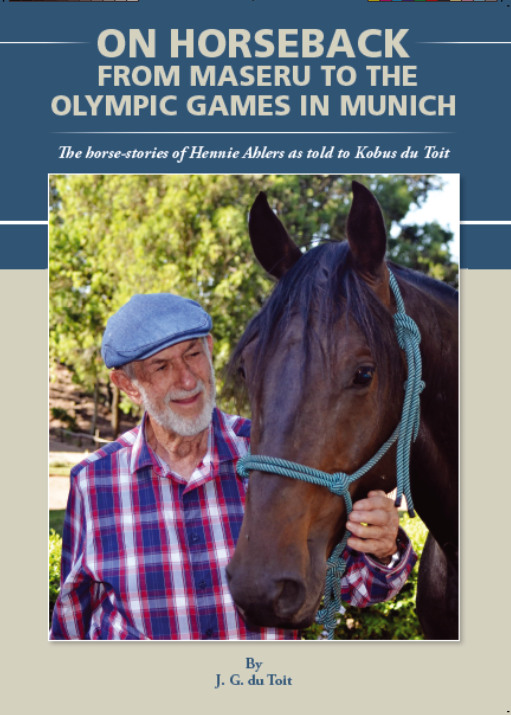
On horseback from Maseru to Munich
On horseback from Maseru to Munich
Estimated Shipping Widget will be displayed here!
Couldn't load pickup availability
The reader may ask why he told this story to me?
Firstly, because he was asked by Celia le Roux to talk about the trip from Maseru to München. Secondly, because of the trip that Nic Claassen and he undertook with their motorbike Ramkat across Africa. The trip was from South Africa to Kenya and Tanzania to the De Beer family in Arusha where the Naysmith’s recuperated before they entered Kenya in 1956. Thirdly, because he was part of a group of 14 people that ride with horses from Worcester to Pretoria in 2002 to honour the Boerperd for its role in the Anglo Boer War. Fourthly, because he grew up in Belfast with indigenous horses in similar cold winters as in Lesotho, the only country in the world where all its territory is more than 1000 meter above sea level. It is entirely surrounded by South Africa, and is situated at the highest point of the Drakensberg escarpment on the eastern rim of the southern African plateau. Fifthly, because of his love for indigenous horses such as the Nooitgedachter Horse, Boerperd and Basotho pony.
Gerrit Hendrik (Hennie) Ahlers was born at Ermelo in the then Transvaal on 12 February 1934. He grew up in Lydenburg where his first contact with horses was of him and his brother travelling more than 10 km to school and back from his father’s farm with a spider horse cart. Because they were small, their father harnessed the horses at home and the older children helped them to outspan them when they arrived at school. He started to ride horses when he was eight years old, and bought his own horse Napoleon, the offspring of a Basotho horse, when he was ten years old.
As a child he used horses to gather sheep and kraaled them at night to prevent jackals from killing them, and used trained jackal hounds to limit the predator impact on the sheep flock as a young man. These dogs were trained by official members of the jackal control club ‘Oranje Jag’. The farmers rented them collectively for a week to hunt jackals in their district. The manager, who was known as the ‘Jagmeester’ (hunting steward), called and controlled the dogs with the crack of a whip during a hunting expedition. The farmers used their own horses to assist with the drive, and the best hunting horse was the indigenous Boerperd.
During these years on the farm, he was fascinated by the qualities of the indigenous horse. When the Department of Agriculture began the Basotho Pony Project to save the Basotho Pony from extinction and create a hardy local horse breed at the Nooitgedacht Research Station in Ermelo in 1952, he became aware that the Nooitgedacht breed was developed from the Basotho pony. He was privileged to buy a stallion and two mares when the government had bred enough horses to sell stock farmers. The Nooitgedachter Breeders’ Society was unofficially formed in his home at a cost of £7 (R14) to create breed standards and guidelines for the breeders of Nooitgedachter horses. His wife Antjie designed the logo that was used to brand the horses.
The core of the story is told by Ria described their trip. Gordon and I met in hospital where I worked as a physiotherapist. He had a painful back, which I treated. The first thing he said was that his back has to come right because he was going to ride across Africa. Silly me, I thought that sounded great, so somehow, I was included. We got married a year later and spent our honeymoon buying horses in the mountains of Lesotho. The trip started on November 2, 1970 from Maseru, Lesotho. Gordon figured it was more than 20 000 kilometers (14 000 miles) to Munich, Germany. If we kept a tight schedule, we thought we could ride that distance in two years.
Author Kobus du Toit
Share